
SIGNALS THROUGH THE NOISE: LATERAL MARKET REPORT
2025 didn't follow that predictable pattern. The ground shifted repeatedly beneath the industry, creating uncertainty that made planning feel like guesswork.
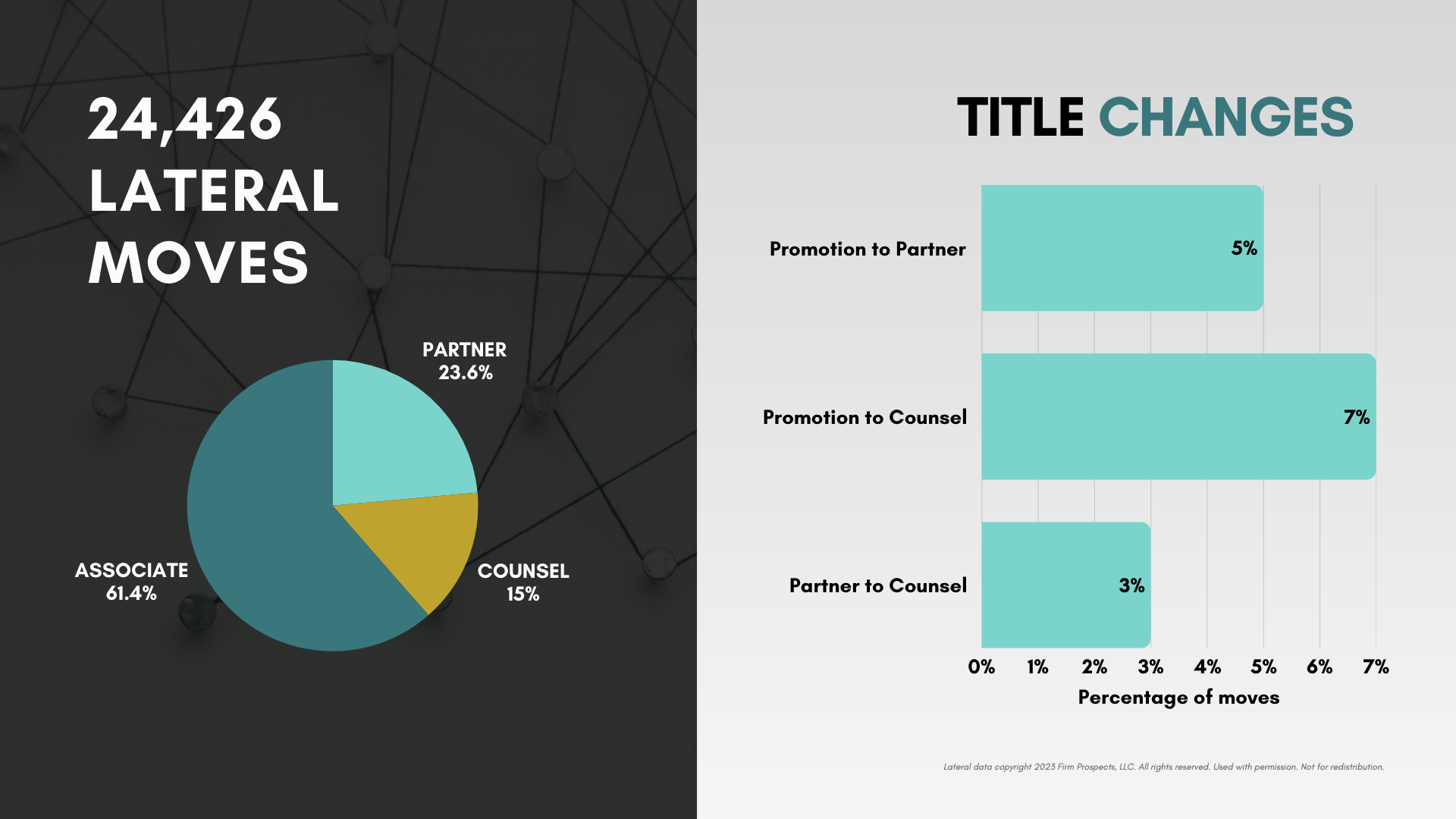
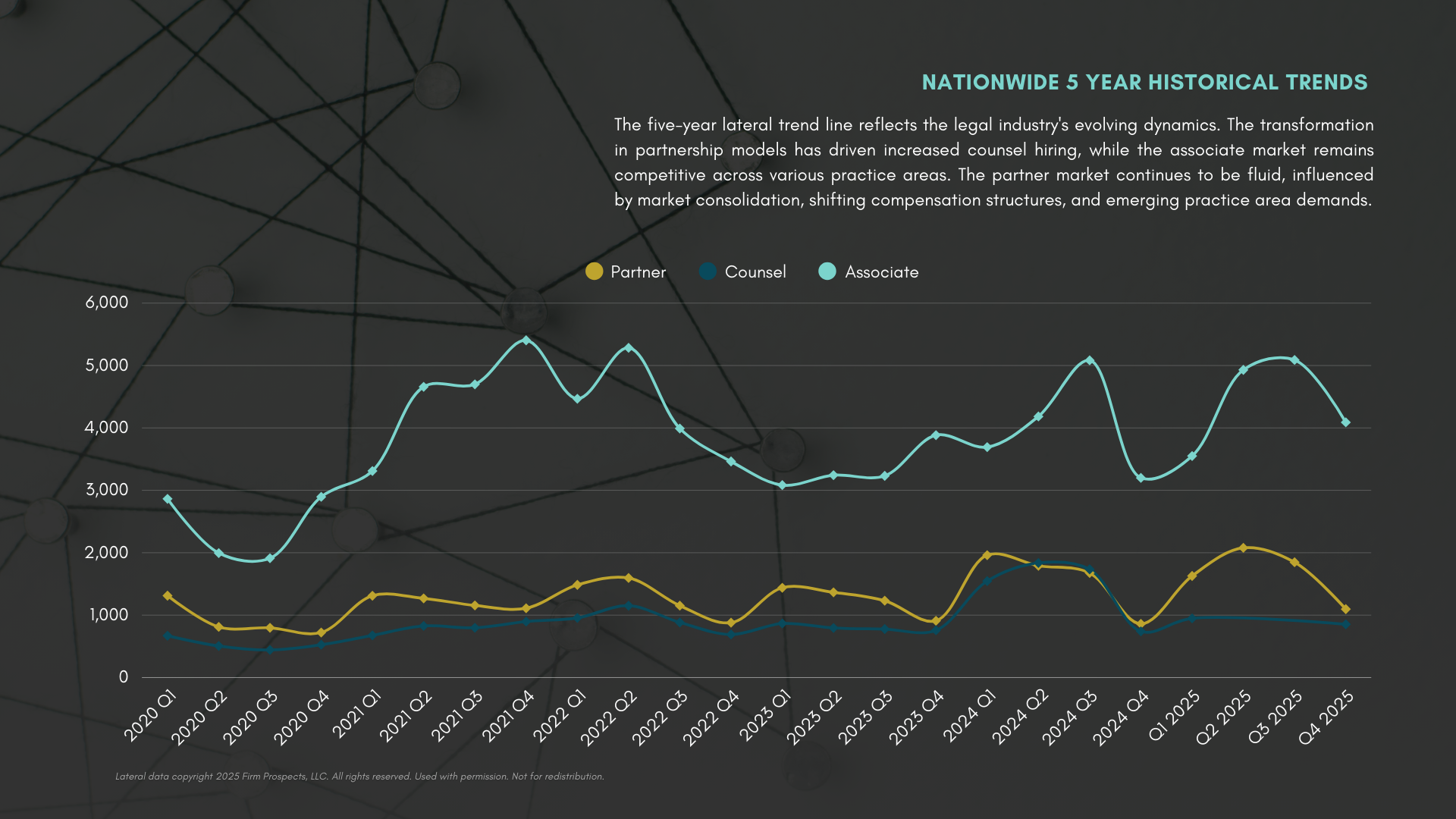
Despite uncertainties, the lateral market held steady, with only 1% fewer moves compared to 2024. Trendlines related to elevated partner and group moves, title changes with lateral movement and mid-levels accounting for ~30% of associate moves continued.
This report looks back on 2025’s lateral market and assesses what 2026 may hold for legal professionals.

Top Stories: Political Pressure and Structural Shifts
The legal industry faced internal and external shocks that are still being resolved.
The "EO Surprise": The administration's executive orders targeting specific law firms were widely viewed as a campaign to coerce firms into abandoning specific clients or causes. While some firms chose to cut deals to avoid fallout, others—and the American Bar Association—fought back in court to protect the rule of law and the right to counsel.
Global Consolidation: 85 mergers were announced in 2025. Many of these combinations were driven by a desire to reach "global elite" status. Firms are finding that to compete for the highest-value "mega-deals" (those over $10 billion), they need a massive international footprint and a diverse range of high-end practices.
DEI Revisions: Under regulatory scrutiny, many firms scaled back or rebranded their diversity and inclusion programs to focus more on general firm culture.
2025 Market Lookback: Normalization and Advancement
There were 24,426 lateral moves in 2025, representing a sustainable lateral pace amidst uncertainty.
The Hunger for Mid-Level Talent: This group accounted for nearly 29% of all moves, reflecting continued high demand for associates who can handle substantive work independently.
The Promotion Engine: Lateral moves have become a primary way to bypass internal bottlenecks. 12% of laterals secured an elevated title with their transition. Common title changes included associates moving into counsel roles and counsel and associate attorneys securing partner titles. Additionally, nearly 9% of attorneys used their move to switch practices entirely, seeking out higher-demand groups or better long-term prospects.
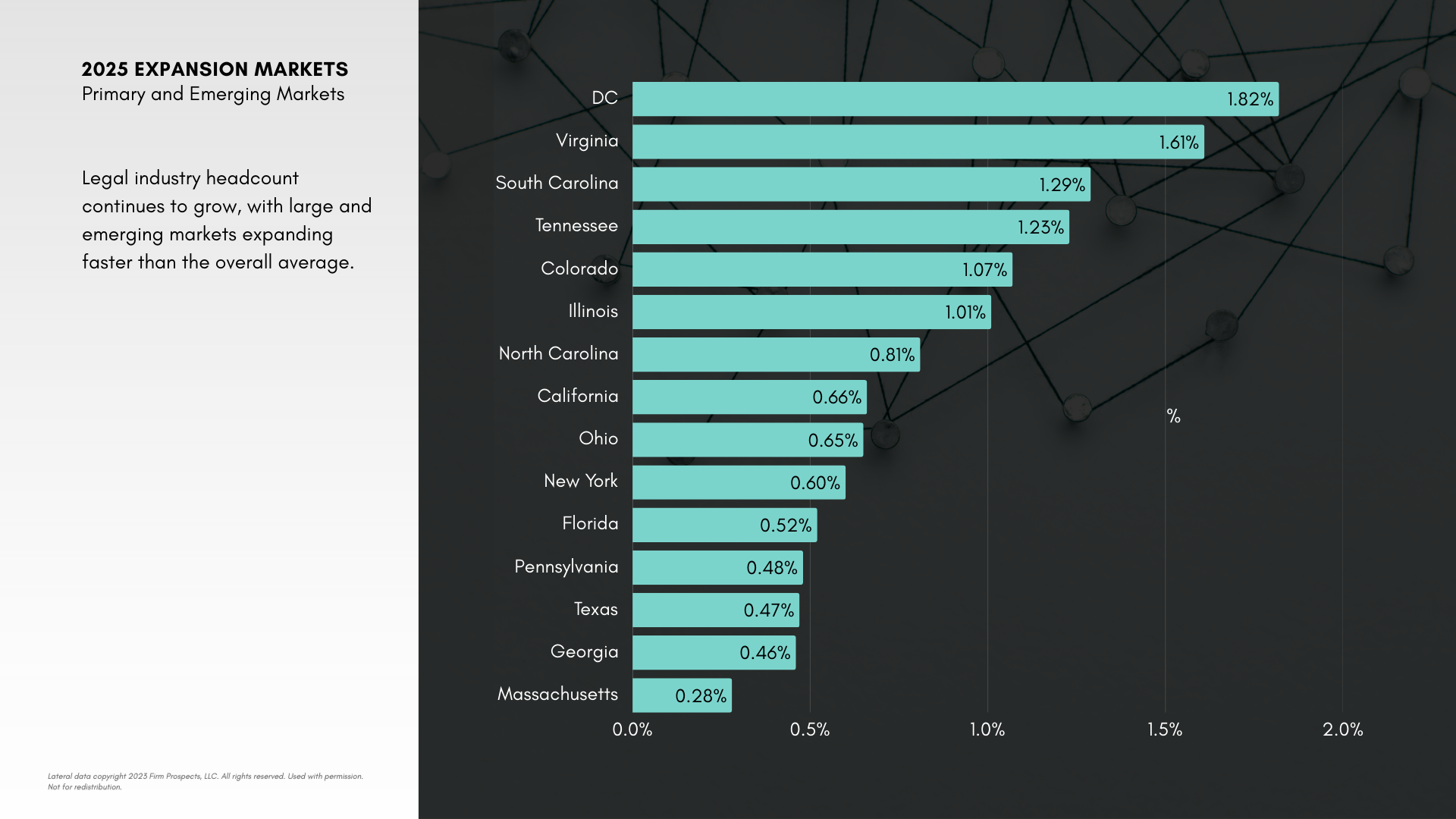
Regional Growth Drivers: Virginia and D.C. didn't just grow by accident. The surge in these markets is tied to the heavy concentration of regulatory and infrastructure work centered around the capital and the growing data center hubs in Northern Virginia.
Practice Drivers
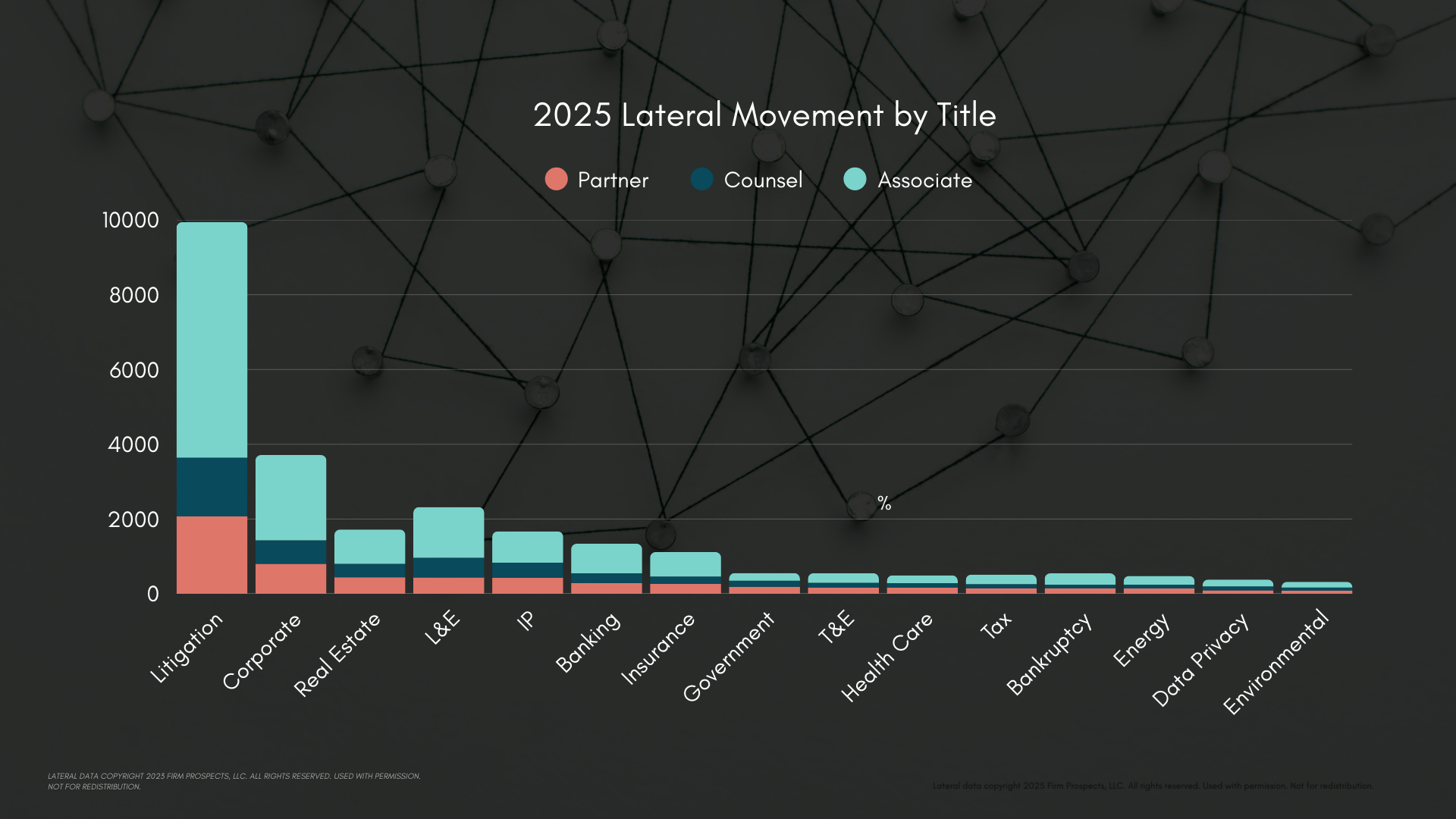
Based on the 2025 data, we are seeing clear signals about where the market was and where it is going. Below is an analysis of the specific drivers behind the activity in these key practice areas.
Litigation
Volume: 9,111 total moves.
The "Why":Litigation historically drives lateral movement. In 2025, disputes increasingly involve high-stakes, "bet-the-company" cases. In 2025, complex claims in cybersecurity, class actions, and regulatory enforcement led corporate clients to boost spending on outside counsel. Firms responded by aggressively recruiting trial-experienced lawyers, as economic uncertainty continued to fuel more commercial disputes.
Corporate (M&A and Private Equity)
Volume: 3,273 total moves.
The "Why": After a quieter period in 2023 and 2024, the corporate market in 2025 entered a "get-back" phase. The resurgence in deal flow was primarily driven by Private Equity sponsors deploying accumulated capital that had been sitting on the sidelines. Additionally, a stabilization in the interest rate environment encouraged a return to deal-making, pushing firms to reload their associate ranks to handle the increased transaction volume.
Real Estate
Volume: 1,517 total moves.
The "Why": Real estate activity surged due to tech-driven demand and renewed international investment. The main driver was the "dirt-to-data-center" construction boom, as tech giants built infrastructure for AI, requiring expertise in land use, zoning, and energy regulation—especially in Texas and Virginia. Complex joint ventures in healthcare and industrial sectors increased to share large project costs. As rates fell and values stabilized, foreign investors re-entered the market, often partnering with domestic firms to navigate new tax rules.
Banking & Finance
Volume: 1,196 total moves.
The "Why": Banking showed a 56% year-over-year increase in moves in 2025. Private credit and alternative lending structures, which have eclipsed traditional bank lending in many sectors, helped fuel this surge. As financial markets adjusted to the 2025 interest rate outlook, borrowers and lenders moved quickly to refinance and restructure debt, creating an immediate need for attorneys with expertise in secured and structured finance.
Intellectual Property
Volume: 1,459 total moves.
The "Why": The 2025 IP market was defined by the intersection of technology and regulation. We saw a spike in litigation and advisory work related to Artificial Intelligence (AI), specifically concerning copyright and authorship of AI-generated content. Simultaneously, traditional patent wars in the semiconductor and telecommunications (5G) sectors remained active, sustaining demand for attorneys with technical backgrounds to navigate complex infringement cases.
Labor & Employment
Volume: 2,076 total moves.
The "Why": This practice area remains active due to a constantly shifting regulatory environment. In 2025, employers faced new state-level compliance hurdles—such as amendments to fair employment laws—alongside continued wage and hour scrutiny. As companies navigated return-to-office mandates and evolving hybrid work policies, they required sophisticated counsel to manage the resulting employee friction and potential litigation.
Health Care
Volume: 435 total moves.
The "Why": Activity here is driven by aggressive government enforcement and consolidation. The Department of Health and Human Services (HHS) and the Office of Inspector General (OIG) ramped up audits in 2025, particularly regarding remote patient monitoring and billing fraud. On the transactional side, Private Equity continued to invest heavily in physician practices and healthcare infrastructure, requiring a hybrid skill set that combines corporate deal-making with regulatory compliance.
Tax
Volume: 456 total moves.
The "Why": Tax hiring in 2025 was largely a derivative of the corporate recovery. As M&A and Private Equity deal flow returned, so did the need for tax attorneys to structure these transactions efficiently. Furthermore, looming expirations of certain tax credits and potential legislative changes require companies to seek high-level strategic tax advice.
Key Market Expansions
Legal industry headcount continues to grow, with large and emerging markets expanding faster than the overall average.
New York:
Remains the center for high-value deals, with 5,361 lateral moves in 2025. While per capita growth (1.87%) lags smaller hubs, the volume of mega-deals ($10B+) keeps elite firms competing for lawyers. Market driven by global M&A and complex finance, favoring attorneys skilled in high-stakes, cross-border matters.
California:
Saw 3,798 lateral moves (1.29% growth), shaped by AI innovation and consumer litigation. San Francisco leads in testing new legal theories, especially around AI, ultra-processed foods, and the environment. Demand is high for attorneys who bridge science, policy, and tech.
Texas:
Became a national leader for AI-related energy and infrastructure, with 2,110 moves (1.53% growth). Data center investment is booming, supported by deregulated energy and tax incentives. Firms seek lawyers experienced in land use, power regulations, and finance.
North Carolina:
Charlotte accounted for 77% of North Carolina’s lateral moves, led by banking and finance. Banking laterals rose 56% year over year, driven by new office openings. Raleigh gained attorneys relocating from larger markets, buoyed by tech and life sciences growth (2.40% arrival rate). Attractive for those seeking corporate, real estate, IP, and litigation roles outside finance-centric cities. The North Carolina market is stable, offering affordable living and a sophisticated work environment.
Georgia:
Atlanta saw 750 moves (1.47% growth). Regional expansion is driven by Labor & Employment and Insurance, with several new offices opening. Attorneys with strong experience can support Atlanta’s diverse corporate sector, from startups to Fortune 500s.
2026 Market Outlook
The legal market in 2026 will be shaped by executive action uncertainty, regulatory overhaul, and transactional momentum. Firms that position themselves now—through both associate development and strategic partner acquisitions—will capture the work generated by these shifts.
Practice Area Outlook & Hiring Implications
Corporate M&A — High Priority
Market Signal: Q3 2025 deal volumes for North American targets hit $822.26 billion—the highest quarterly figure in 10 years. Year-to-date totals already surpass every annual total since 2015 except for 2021's record.
What to Look For in Associates:
Experience on both buy-side and sell-side transactions.
Exposure to cross-border deals (Middle East and African buyers tripled their spending on North American targets this year).
Technology sector transaction experience, particularly AI-related investments.
Ability to manage multiple workstreams and coordinate with specialists.
Partner Acquisition Opportunities:
M&A partners with established relationships with sovereign wealth funds and international investors.
Partners with technology transaction experience, given the AI infrastructure buildout.
Consider partners who can bring cross-border deal flow from the Middle East and Asia Pacific regions.
Restructuring & Bankruptcy — High Priority
Market Signal: Chapter 12 bankruptcy filings surged nearly 50% through mid-October compared to the same period in 2024. Immigration enforcement is creating labor shortages that cascade into contract failures and insolvency for industries, like family farms.
What to Look For in Associates:
Familiarity with force majeure analysis and contract interpretation.
Experience with agricultural clients or labor-intensive industries.
Understanding of 11 U.S.C. §365 (contract rejection) and §502(b) (creditor claims).
Commercial litigation background that can translate to adversarial bankruptcy proceedings.
Partner Acquisition Opportunities:
Partners who handle debtor-side and creditor-side work with diversified client bases.
Look for partners with experience in agriculture, construction, hospitality, or logistics—industries heavily affected by immigration enforcement.
Prioritize markets with strong regional bankruptcy courts.
Real Estate — High Priority
Market Signal: Real Estate had 1,517 lateral moves in 2025, making it a top area for talent. The AI-driven data center boom remains a major factor, but joint venture (JV) activity is rising across sectors. Large healthcare and industrial projects use consortiums and JVs to share capital and risk. Foreign investors returning in 2026 are also favoring JVs with U.S. partners to navigate regulations and the "One Big Beautiful Bill" tax policy.
What to Look For in Associates:
Experience drafting and negotiating complex joint venture and partnership agreements, specifically for industrial, healthcare, or commercial developments.
Deep understanding of land use and zoning regulations in high-growth markets like Texas and Virginia to support "dirt-to-data-center" projects.
Background in construction law and the capacity to evaluate force majeure claims related to government-induced labor shortages.
Experience working with international clients on tax-efficient property structures and cross-border business advice for property acquisitions.
Partner Acquisition Opportunities:
Target partners who specialize in multi-party JV structuring within the healthcare and industrial sectors, where capital-intensive collaborations are becoming the norm.
Prioritize partners with strong ties to sovereign wealth funds and international private equity firms seeking domestic joint-venture entry points.
Look for practitioners who can handle the energy-linked real estate needs of the data center industry, which requires a blend of infrastructure and property law expertise.
Identify partners with a proven track record in construction and restructuring who can help JV entities manage contract failures and insolvency risks in a shifting labor market.
Intellectual Property Litigation — Growing Demand
Market Signal: The International Trade Commission will see increased filings due to (1) the Lashify decision expanding the domestic industry requirement, and (2) growing skepticism in the Northern District of Illinois toward Schedule A cases involving ex parte TROs.
What to Look For in Associates:
ITC experience or strong interest in learning Section 337 proceedings.
Patent, trademark, or design patent enforcement background.
Experience handling cases against foreign defendants and jurisdictional challenges.
Partner Acquisition Strategy:
Target IP partners with ITC trial experience—this remains a niche skillset.
Look for partners serving direct-to-consumer businesses, which are projected to grow 14.5% next year.
Consider partners who can pivot between traditional district court litigation and ITC proceedings.
Regulatory & Administrative Law — High Priority
Market Signal: 158 APA suits have been filed in 2025, challenging the implementation of executive orders. Discovery requests in APA cases have hit a 10-year high, and courts are increasingly allowing plaintiffs to take discovery, including deliberative process materials.
What to Look For in Associates:
Experience with Administrative Procedure Act litigation.
Background in government investigations or enforcement defense.
Familiarity with injunctive relief and preliminary relief standards.
Understanding of executive authority and constitutional law arguments.
Partner Acquisition Opportunities:
Partners with experience challenging or defending agency actions.
Prioritize those with established relationships with trade associations or industry groups likely to bring APA challenges.
Look for former government attorneys with agency experience.
Labor & Employment — Strategic Opportunity
Market Signal: The NLRB may be declared unconstitutional following the SpaceX case. If the Supreme Court strikes down the board's structure, a regulatory void will emerge. New York and California have already passed laws allowing state agencies to hear private-sector labor disputes.
What to Look For in Associates:
Traditional labor law experience (union negotiations, ULP proceedings).
Multi-state employment counseling capability.
Familiarity with state labor agency processes in New York and California.
Litigation experience for the wave of challenges that may follow.
Partner Acquisition Opportunities:
Labor partners who can advise clients through regulatory uncertainty.
Prioritize partners with state-level labor board experience, particularly in states establishing their own enforcement frameworks.
Consider building out labor capacity in New York and California, specifically.
Digital Assets & Cryptocurrency — Growth Area
Market Signal: The SEC is proposing six crypto-related rules and has adopted a more crypto-friendly posture. Digital asset treasuries (DATs) are proliferating—over 80 were created in 2025—and litigation over DAT mergers is beginning.
What to Look For in Associates:
Securities regulatory background with interest in digital assets.
M&A experience that can translate to DAT merger disputes.
Shareholder litigation experience (valuation disputes will drive claims).
Comfort with emerging technology and blockchain concepts.
Partner Acquisition Strategy:
Target securities partners who have developed crypto practices.
Look for partners who can handle both transactional work (helping clients navigate new SEC rules) and litigation (defending against shareholder challenges).
Prioritize partners who have relationships with crypto exchanges, mining companies, or fintech firms.
Healthcare & Pharmaceutical Regulatory — Steady Demand
Market Signal: The 340B Drug Pricing Program is facing new challenges. Drugmakers recently won their first court victory in West Virginia, and the Trump administration launched a rebate pilot program that shifts financial risk to hospitals and clinics.
What to Look For in Associates:
Healthcare regulatory experience, particularly with HHS and HRSA.
Understanding of drug pricing structures and Medicaid rebates.
Litigation experience for the contract pharmacy access disputes.
Familiarity with hospital and health system operations.
Partner Acquisition Opportunities:
Partners who represent either drugmakers or covered entities (hospitals/clinics).
Prioritize partners with appellate experience—several circuit courts will likely weigh in.
Consider partners who can advise on compliance with evolving rebate structures.
Banking& FinANCE — Transactional & Compliance PRiority
Market Signal: Banking moves rose 56% in 2025, as firms built capacity for a high-volume transactional and regulatory year. Demand is being driven by a "gold rush" for data center infrastructure, which requires energy and real estate financing, a maturing securitization market, and the financing needs of mega-M&A deals. Simultaneously, banks must navigate state-level enforcement actions by 21 attorneys general and new executive orders on "debanking," while balancing traditional risk management with discrimination investigations.
What to Look For in Associates:
Sophisticated experience in structured finance, fund finance, and leveraged finance to support a record year for North American M&A.
Strong background in real estate finance and project finance, particularly for large-scale energy and infrastructure developments.
Ability to defend against state-level consumer protection actions as state agencies fill the gap left by a defunded CFPB.
Knowledge of AML/BSA frameworks and risk management to handle the compliance friction created by new debanking mandates.
Partner Acquisition Strategy:
Prioritize finance partners with "dirt-to-data-center" experience who can handle the full lifecycle of infrastructure projects involving real estate and energy finance.
Target partners with established relationships in private equity and fund finance, given the projected breakout year for international and domestic deals.
Look for practitioners who can help banks recalibrate their risk guidelines to avoid federal investigations while maintaining traditional safety and soundness.
Identify partners capable of integrating traditional banking counsel with the emerging SEC framework for digital asset registration.
Privacy & Artificial Intelligence — Emerging
Market Signal: No new state comprehensive privacy laws passed in 2025—a notable pause. Instead, states are focusing on AI-specific legislation (California, Texas, Pennsylvania, and Montana all passed AI laws). Colorado's comprehensive AI Act takes effect in June 2026.
What to Look For in Associates:
Privacy compliance experience (CCPA, state privacy laws).
Emerging interest in AI governance.
Data security and breach response background.
Cross-functional experience working with technology and business teams.
Partner Acquisition Strategy:
Target privacy partners who are developing AI governance practices.
Look for partners who can advise on state-by-state AI compliance.
Consider partners with experience in algorithmic decision-making and bias audits.
Strategic Advice for Leaders
The firms that will gain ground in 2026 are those acting now—not waiting for regulatory clarity or market stability. Build associate benches in M&A, restructuring, and regulatory practices before deal flow peaks and the talent pool thins. Target partner acquisitions strategically: prioritize those that bring established client relationships in high-growth sectors such as AI infrastructure, digital assets, and cross-border transactions. Pay attention to the regional shifts—Texas and Virginia are becoming centers of gravity for energy and regulatory work. Most importantly, recognize that lateral movement has become a primary mechanism for attorneys' advancement. If your internal promotion pathways are clogged, your best people will leave. Firms that invest in talent development and strategic hiring during uncertainty emerge stronger when the market stabilizes. Those who wait will spend 2026 playing catch-up.
Strategic Advice for Candidates
If you're waiting for the "right time" to explore your options, you're already behind. The 2026 market rewards those who position themselves ahead of demand, not those who react to it. Associates in their fourth through seventh years should be particularly strategic right now—you're the most sought-after group, which means you have leverage. Use it to find a platform where you can actually build a practice, not just bill hours. Pay attention to title changes with lateral moves: 16% of attorneys used their transition to elevate from associate to counsel or counsel to partner. If your current firm's partnership track is stalled, moving may be your only path forward.
For Partners, portability still matters, but firms are increasingly focused on synergistic relationships that generate new work alongside maintaining existing clients. If you're sitting on a book in a stagnant practice area, start developing adjacencies now.
The biggest mistake candidates make is treating lateral moves as something you do when things get bad. Attorneys advancing their careers are those who treat movement as a strategic asset. Know your market value, understand where demand is heading, and make your move when you have options, not when you're desperate.